


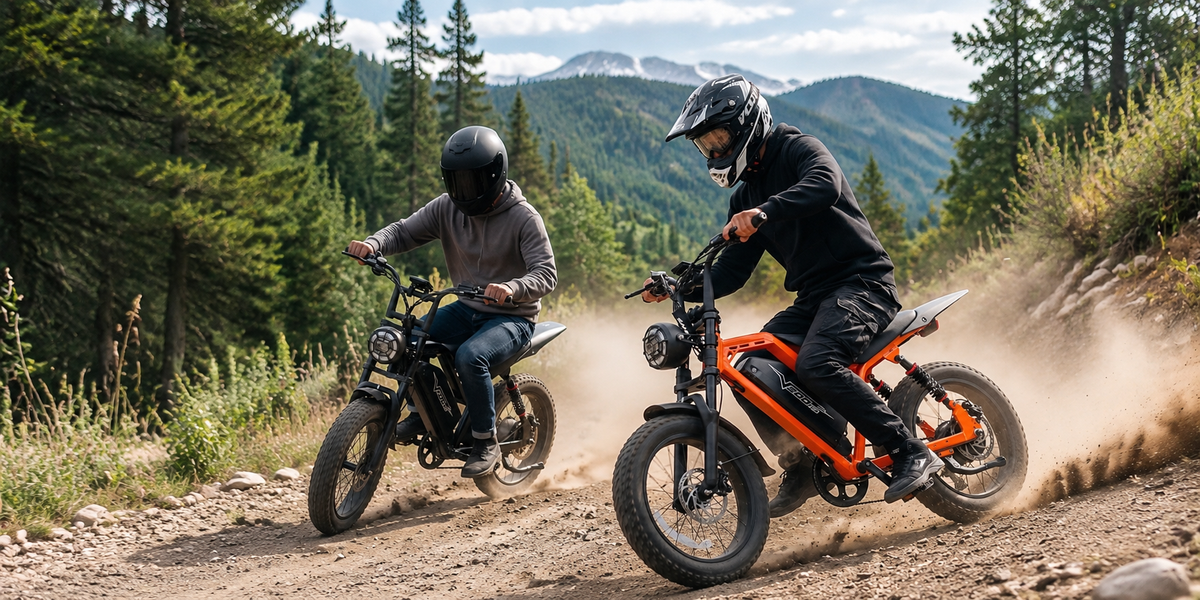
Planning a longer weekend ride means thinking beyond the destination. Riders also need to consider whether their battery has enough charge for the journey home.
The ESKUTE V200 Pro comes equipped with a 52V 20.8Ah battery and an advertised range of up to 80 miles. Combined with its 2000W peak motor and seven-speed drivetrain, this setup gives riders flexibility when planning recreational rides across different routes and surfaces.
However, advertised range and everyday riding distance are not always the same. Riding speed, terrain, rider weight, and throttle use all influence battery consumption. Understanding these factors can help you plan more realistic routes and get better use out of every charge.

What Does the V200 Pro's 52V 20.8Ah Battery Offer?
The V200 Pro features a 52V 20.8Ah battery, providing the energy needed to power its electric drive system.
The 52V rating describes the battery's nominal voltage, while 20.8Ah indicates its amp-hour capacity. Together, these specifications help explain the battery configuration behind the bike's advertised performance.
For riders, the value goes beyond the numbers. A substantial battery capacity offers more flexibility when planning longer recreational outings, whether that means exploring countryside roads, following local dirt trails, or combining different types of terrain.
The battery also works alongside the V200 Pro's 2000W peak motor. The motor provides electric assistance when riders accelerate or encounter changing terrain, while the battery supplies the energy needed to support that performance.
For buyers, the important consideration is how this combination fits their typical riding distance, preferred speed, and route conditions. Your riding speed and acceleration habits influence battery consumption. Learn more about the V200 Pro's motor performance and how its power supports different riding situations.
How Far Can the ESKUTE V200 Pro Go on a Single Charge?
The ESKUTE V200 Pro offers an advertised range of up to 80 miles on a single charge.
This makes it worth considering for recreational riders who want the flexibility to plan longer outings rather than limiting every trip to a short local route.
However, the phrase "up to" matters. Eighty miles represents the maximum advertised range, not a guaranteed distance for every rider or riding condition.
Actual range varies depending on several factors. A rider maintaining a moderate pace on relatively flat roads may use battery energy differently from someone who frequently accelerates, travels at higher speeds, or tackles repeated uphill sections.
It is also important to distinguish maximum speed from maximum range. The V200 Pro is advertised with a top speed of up to 40 MPH, but maintaining high speeds generally requires more energy. Riders should not expect to achieve maximum speed and maximum advertised range simultaneously under the same conditions.
For practical planning, consider the 80-mile figure a reference point. Your expected riding speed, route profile, total load, and use of electric assistance will help determine a more realistic distance for your outing.
What Affects the V200 Pro's Real-World Battery Range?
Several factors influence how far an electric bike can travel on one charge. Understanding them can help you make better decisions before setting out.
Riding Speed and Throttle Use
Speed is one of the most noticeable influences on battery consumption.
Maintaining a consistently high speed generally requires more energy than riding at a moderate pace. Frequent acceleration also increases energy demand, particularly when repeatedly speeding up after slowing down.
Consider two riders covering the same countryside route. One maintains a steady pace, while the other frequently accelerates, brakes, and speeds up again. Their energy consumption may differ even though they travel the same distance.
For V200 Pro riders, smoother throttle use and avoiding unnecessary bursts of acceleration can help manage battery consumption.
If covering more ground is your priority, consider whether you need to ride at maximum speed throughout the trip.
Rider Weight and Additional Cargo
The total load carried by the bike also affects energy consumption.
A rider's weight, backpack, protective equipment, and other cargo all contribute to the overall load. Moving more weight generally requires additional energy, especially when accelerating or traveling uphill.
The V200 Pro has a maximum payload capacity of 360 lbs, giving buyers a useful reference when considering rider weight and additional equipment.
However, staying within the maximum payload limit does not mean every load will produce the same range. Two riders carrying different amounts of equipment may experience different battery consumption even when both remain within the specified limit.
For longer outings, bring the equipment you need without adding unnecessary weight.
Terrain and Elevation Changes
Where you ride matters just as much as how you ride.
A relatively flat paved route places different demands on the bike than a trail with repeated climbs, uneven surfaces, and changing gradients. Uphill sections require additional energy, while loose or rough surfaces can make forward movement more demanding.
For example, a countryside loop with several uphill sections may require more battery energy than a route of the same distance on relatively flat roads.
This is why distance alone is not enough when estimating how much charge you need.
When planning a route with significant elevation changes, consider the entire journey, including the return trip. Avoid assuming that the outward and return sections will consume identical amounts of energy. If your routes include frequent uphill sections, our guide to V200 Pro hill climbing performance offers a closer look at its climbing capabilities.
Pedal Assist and Riding Habits
How much effort the rider contributes through the pedals can also influence battery use.
The V200 Pro combines electric assistance with a seven-speed drivetrain, allowing riders to adjust mechanical gearing as the route changes.
When approaching an incline, selecting a suitable lower gear can help maintain a comfortable pedaling rhythm. On flatter sections, riders can adjust their gearing to suit their preferred pace.
Using the pedals as part of the ride can reduce reliance on the motor compared with depending entirely on the throttle. The actual effect on range varies with terrain, speed, rider effort, and other conditions.
There is no single gear or assistance setting that guarantees a particular mileage. The goal is to find a comfortable balance between pedaling effort, speed, and battery consumption.
For riders who enjoy staying involved in the ride rather than relying entirely on electric power, this combination of motor assistance and mechanical gearing offers additional flexibility.
Temperature and Weather Conditions
Weather can influence both battery performance and the energy needed to complete a ride.
Cold temperatures can temporarily reduce the available performance of lithium-ion batteries. A bike that performs normally in mild weather may offer less usable range in colder conditions.
Wind creates another challenge. Riding against a strong headwind increases resistance and can require more energy to maintain the same speed.
Wet, soft, or uneven surfaces may also make riding more demanding than firm, dry ground.
If you plan to ride in colder weather or during windy conditions, avoid relying too closely on the maximum advertised range. Allowing extra battery reserve gives you more flexibility when conditions are less favorable than expected.
How Do Different Riding Conditions Affect Battery Consumption?
The following examples illustrate why two rides of the same distance can produce different results.
| Riding scenario | Expected battery demand |
|---|---|
| Steady riding on relatively flat roads | Generally lower energy demand |
| Frequent acceleration and high-speed riding | Higher energy demand |
| Repeated uphill climbs | Higher energy demand |
| Mixed terrain with changing surfaces | Varies with terrain and riding style |
| Cold weather and strong headwinds | May reduce available range |
These are general riding comparisons rather than measured V200 Pro range results. Your actual experience will depend on the combination of conditions throughout the trip.
How Long Does It Take to Charge the V200 Pro Battery?
The ESKUTE V200 Pro has an advertised charging time of approximately 7–8 hours.
For everyday riders, this makes overnight charging a practical way to prepare for the next day's ride.
If you have a longer weekend adventure planned, check the battery level the evening before and allow enough time for charging. Building this into your regular routine helps ensure the bike is ready when you are.
Before extending a ride, consider the remaining charge alongside the distance ahead, terrain, and expected return journey. The battery indicator is useful, but it should not be your only reason to add another loop, especially when the route includes climbs or changing weather.
Always use the charger supplied with your bike and follow the manufacturer's charging instructions.
How to Get More Range from Your V200 Pro
A few practical riding habits can help you make better use of the V200 Pro's available battery capacity.
1. Maintain a Steady Riding Speed
Avoid unnecessary bursts of acceleration and prolonged high-speed riding when covering longer distances.
2. Choose the Right Gear
Use the seven-speed drivetrain to find a comfortable pedaling gear for the terrain ahead, especially when approaching uphill sections.
3. Check Tire Pressure
Check tire pressure before setting off and keep it within the manufacturer's recommended range. Proper inflation helps avoid unnecessary rolling resistance.
4. Plan Your Route
Consider the total distance, elevation changes, and return journey before adding extra stops or detours. Leave enough battery reserve for the ride home.
5. Avoid Unnecessary Load
Carry essential riding equipment, but leave behind items that add weight without serving a purpose.
These adjustments can help manage battery consumption, although actual range will always depend on the overall riding conditions.
Is the V200 Pro Battery Suitable for Your Riding Needs?
The V200 Pro's 52V 20.8Ah battery and advertised range of up to 80 miles make it worth considering for riders who want flexibility when planning recreational outings.
Whether it suits your needs depends on how far you typically ride, how fast you prefer to travel, and the terrain you encounter.
Weekend Explorers
If you enjoy exploring countryside roads, local trails, and unfamiliar destinations on weekends, battery capacity can make a real difference to your planning.
The V200 Pro's advertised range provides a useful reference when considering longer weekend routes. You can look beyond short local rides while accounting for elevation changes and expected battery consumption.
Recreational Riders
For riders who regularly head out for relaxed afternoon rides, a substantial battery capacity offers more flexibility between destinations and outings.
If you enjoy spending more time riding without limiting every trip to a short familiar route, the V200 Pro's battery configuration is worth considering. Your preferred pace and typical riding distance will help determine how well its range suits your routine.
Mixed-Terrain Riders
If your usual routes combine paved roads, dirt paths, and rolling trails, range planning becomes more important than distance alone.
The V200 Pro combines its battery capacity with electric assistance and a seven-speed drivetrain, giving riders flexibility in how they approach different sections of a route.
However, changes in surface and elevation should be considered when estimating the energy needed for the entire journey.
When Should You Plan More Conservatively?
Some riding conditions call for a more cautious approach to range planning.
Riders who frequently travel at high speeds, tackle repeated climbs, or carry heavier equipment should allow for greater battery consumption.
The advertised 80-mile range is a maximum figure, not a guaranteed result under demanding conditions. If your regular routes involve these factors, plan a shorter distance and leave sufficient battery reserve for the return journey.
ESKUTE V200 Pro Battery & Range FAQs
How Many Miles Can the ESKUTE V200 Pro Travel on One Charge?
The ESKUTE V200 Pro offers an advertised range of up to 80 miles per charge. Actual distance depends on riding speed, rider weight, terrain, weather, and how much the rider relies on electric assistance versus pedaling.
What Battery Does the V200 Pro Use?
The V200 Pro is equipped with a 52V 20.8Ah battery. This configuration supplies energy to the bike's electric drive system and supports its advertised range of up to 80 miles.
How Long Does It Take to Charge the V200 Pro?
The advertised charging time is approximately 7–8 hours. Charging overnight is a convenient option for riders preparing for their next outing. Always follow the manufacturer's charging instructions and use the supplied charger.
What Factors Affect the V200 Pro's Battery Range?
Several factors influence real-world range, including riding speed, throttle use, rider and cargo weight, terrain, pedaling habits, temperature, and wind conditions. A combination of these factors determines how much energy a particular route requires.
Does Riding at 40 MPH Reduce Battery Range?
Generally, yes. Higher-speed riding requires more energy than maintaining a moderate pace, particularly when sustained over longer distances. The V200 Pro's advertised maximum speed and maximum range are separate performance figures and should not be expected simultaneously under the same riding conditions.
How Can I Extend the Battery Range of My V200 Pro?
Maintain a steady riding speed, avoid unnecessary acceleration, choose suitable gears, check tire pressure, and reduce unnecessary cargo. Planning your route and leaving enough battery for the return journey are also important.
Final Thoughts: Plan Your Next Ride with the ESKUTE V200 Pro
A long-range electric dirt bike should offer more than an impressive number on a specification sheet. It should give riders the flexibility to plan their outings around the routes they enjoy and the distances they want to cover.
The ESKUTE V200 Pro combines a 52V 20.8Ah battery, an advertised range of up to 80 miles, and an approximately 7–8-hour charging time. This makes it worth considering for weekend explorers, recreational riders, and those who enjoy covering different types of terrain.
The key is understanding how your riding habits and route conditions influence actual battery consumption. With sensible speed management, appropriate gearing, and a little route planning, you can make better use of the available charge and approach longer rides with greater confidence.
Planning your next weekend adventure? Explore the ESKUTE V200 Pro and discover whether its battery capacity and range are right for your riding needs.


Share:
ESKUTE V200 Pro Hill Climbing: How Well Does It Handle Challenging Hills?
ESKUTE V200 Pro Suspension & Tires: How Comfortable Is It on Rough Terrain?