
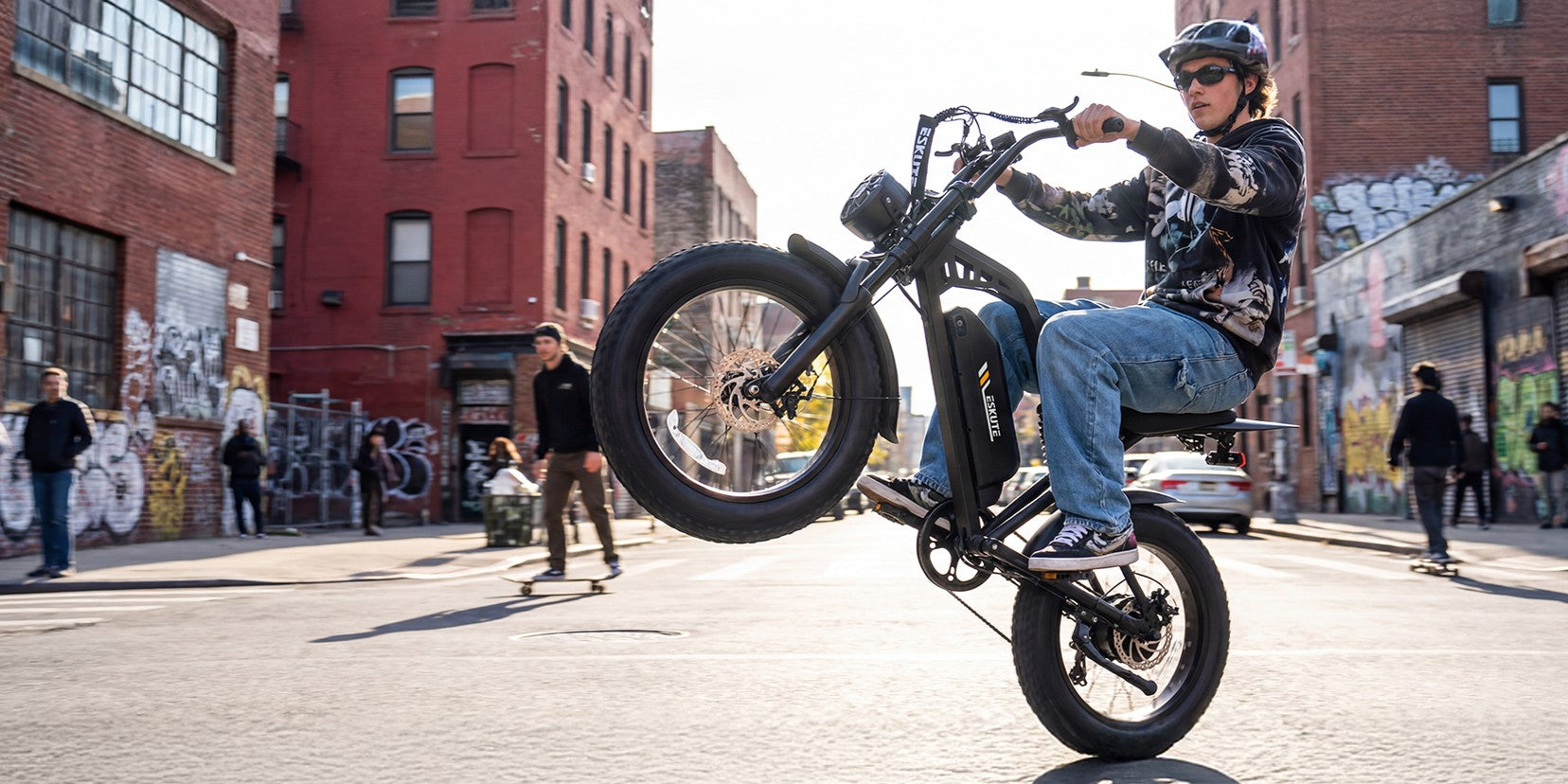
If you've been eyeing moped style ebikes lately, you're not alone. These electric rides are having a moment, and 2026 is shaping up to be their booming year. New electric bikes are pushing boundaries in speed, comfort, and user experience like never before.
What Makes Moped Style Ebikes Faster and More Powerful in 2026?
The performance jump in new electric bikes this year is hard to ignore. Let's break down what's driving these improvements and what they mean for riders.
Motor Power and Performance Upgrades
Many moped style ebikes in the U.S. are built around “750W-class” motors, because the federal consumer definition of a low-speed electric bicycle caps motor power at 750W (1 hp) and assisted speed at 20 mph.
For a real-world example, Eskute’s V100 and V200 are built for punchier takeoffs, with up to 1500W peak power (V100) and up to 1300W peak power (V200). If you want a true mini-moto riding feel, the Nova Mini takes things further with a 3500W peak mid-drive motor, where the advantage is most noticeable in instant launch torque, climbing extremely steep grades, and strong second-stage acceleration—delivering a far more aggressive and responsive ride under demanding conditions.
Battery Technology Advancements
Battery tech has taken a big leap forward. Modern lithium‑ion systems commonly use battery capacities from ~600 Wh up to 1000 Wh+, often expressed as 48 V 15–20 Ah packs. That translates to realistic range figures of roughly 25–70+ miles per charge, depending on riding style, terrain, and assistance modes.
Charging times vary by capacity and charger type. With higher‑wattage chargers, most large‑capacity e‑bike packs can be replenished significantly (e.g., up to ~80 %) in a few hours.
Speed Comparisons: 2025 vs 2026
While e‑bikes that meet U.S. federal definitions are often limited at 20 mph to 28 mph for assisted riding, some performance‑oriented bikes capable of higher speeds (often beyond regulatory e‑bike limits) achieve top speeds in the ~30–40 mph range under throttle in off‑road or unrestricted contexts.
To put that into relatable numbers, bikes like the Eskute V100 (up to 28MPH) and V200 (up to 29MPH) sit right around the “fast e-bike” experience many riders want for commuting, while the Nova Mini can reach up to 38MPH, which lands more in the high-performance, fun-first category (and worth double-checking local rules before riding it like a moped on public roads).
Legal Speed Limits and Classifications
Electric bike classification remains standardized around three main U.S. classes:
- Class 1: pedal‑assist up to 20 mph
- Class 2: throttle‑or‑pedal‑assist up to 20 mph
- Class 3: pedal‑assist up to 28 mph (throttle limits usually lower)
Anything capable of higher speeds or motor power above the typical e‑bike regime may be regulated as a moped, requiring registration, insurance, or other credentials depending on the state.
The Fastest Electric Bikes of 2026
Performance-oriented e-bikes can deliver higher top speeds and stronger acceleration than typical commuter models, making them a great choice for riders who want a more powerful ride feel. They’re especially popular for open-road cruising, longer routes, and recreational riding where extra performance makes the experience more fun and effortless.
How Have New Electric Bikes Become Smoother to Ride?
Speed is great, but comfort matters just as much for real-world riding. The improvements here might be even more impressive than the power gains.
Advanced Suspension Systems
Rear suspension is especially critical in electric bikes. A truly effective rear shock requires a complete redesign of the bike’s overall structure rather than a simple add-on, demanding higher frame strength and manufacturing precision. A well-engineered rear suspension greatly improves stability, allowing the bike to glide smoothly over rough terrain with strong traction. Paired with fat tires, it becomes ideal for mountain riding, off-road exploration, and complex terrain.
This is also why the newer “moped-style” bikes keep showing up as a TikTok trend—especially with teens and younger riders—because they’re not just commuting tools, they’re legitimately fun to ride. Models like Eskute’s V100, V200, and Nova Mini lean into that moto-inspired look, while adding practical comfort upgrades like a dual-suspension setup (front fork + rear shock) and fat tires that feel more confident on rough pavement, broken streets, and mixed surfaces (so “exploring” doesn’t have to stop at smooth bike lanes).

Frame Geometry Improvements
Manufacturers have rethought frame designs from the ground up. Longer wheelbases improve stability at higher speeds, while slacker head angles make steering feel more planted. Seat positions have been optimized, too, reducing back strain on longer rides. The result is bikes that feel composed and confidence-inspiring rather than twitchy or uncomfortable.
Vibration Dampening Features
Beyond suspension, engineers are tackling vibration in clever ways. Rubber isolation mounts for motors reduce buzzing through the frame. Thicker handlebar grips absorb road chatter. Even tire compounds have been reformulated to balance grip with comfort. These small touches add up to a remarkably smooth ride.
Tire and Braking Technology Upgrades
Speaking of tires, the coolest electric bikes now roll on wider rubber, often using “fat tire” formats for added traction and comfort. Braking has kept pace with the power increases. Hydraulic disc brakes are widely used on performance-focused builds, and rotor sizing varies by design and intended speed.
Why Are the Coolest Electric Bikes Easier to Operate?
Raw performance means nothing if you can't use it comfortably. Thankfully, 2026's moped style ebikes are the most user-friendly yet.
User-Friendly Control Systems
Gone are the days of confusing button combinations. Modern controls are intuitive, often featuring a twist throttle and a simple mode selector. You can switch between different assist levels / speed modes without taking your eyes off the road. Instead of extra “smart” gimmicks, this kind of simple control layout is what makes teen-friendly moped-style bikes easier to pick up fast.
Simplified Display Interfaces
Clear LCD-style displays have replaced the tiny monochrome screens of older bikes. You can see your speed, battery level, trip distance, and power mode at a glance. Many setups keep it straightforward, focusing on the essentials you actually check while riding—without needing app syncing or extra menus. The information is there when you need it, but doesn't overwhelm you with data.
Throttle and Pedal Assist Modes
The fastest electric bikes offer both throttle-only and pedal-assist riding. Twist-throttle mode works like a scooter, turn and go. Pedal assist kicks in when you're pedaling, amplifying your effort. Most bikes offer multiple assist levels, letting you dial in exactly how much help you want. It's flexibility that makes these bikes work for fitness rides and lazy cruises alike.
Clear Controls and Instant Riding Feedback
Rather than focusing on “smart” features, what matters most to riders is a fast, reliable response. A clear, easy-to-read display that instantly shows speed, riding mode, and battery status allows riders to stay focused on the road or trail. Simple controls with quick feedback make the riding experience more intuitive, safer, and confidence-inspiring—especially in changing terrain or demanding conditions.
Are Moped Style Ebikes Worth the Investment in 2026?
Let's talk dollars and cents. These bikes aren't cheap, but they might save you money in the long run.
Price Range and Value Analysis
Moped-style e-bikes typically run $1,200–$2,500, with high-spec models costing more. By contrast, the V100/V200 delivers full configurations under $1,000—saving money and hassle. The Nova Mini pairs a 3,500W peak motor with a $1,0xx price, offering stronger power, quicker acceleration, and class-leading specs. If you want bigger performance for less—whether for commuting or weekend fun—these three are easy top picks.

Top Models: Performance vs. Design vs. Value
The market offers something for everyone. Performance-focused bikes prioritize power and speed. Design-oriented models emphasize style and build quality. Value picks balance features against price. Your choice depends on what matters most to you and how you'll use the bike.
Long-Term Cost Considerations
Maintenance is minimal compared to gas vehicles. You'll need to charge the battery, which often costs well under $1 per full charge, depending on local electricity rates. Tires, brake pads, and chains need periodic replacement, but these are cheap compared to car maintenance. Battery replacement is often the biggest long-term expense, and costs vary widely depending on battery capacity, cell type, and brand availability.
Ideal Usage Scenarios
Moped style ebikes shine for commutes under 20 miles. They're perfect for errands around town, especially in areas with bike lanes or trails. They work great for recreational rides where you want to cover ground without arriving sweaty.
FAQ
Q1. Can I Ride a Moped-Style E-bike in Bike Lanes?
This depends entirely on your local laws and the bike's classification. Class 1 and Class 2 e-bikes under 20 mph are generally allowed in bike lanes across most U.S. cities. Class 3 bikes, hitting 28 mph, face more restrictions; some areas ban them from bike paths entirely. High-powered models exceeding these speeds typically count as motor vehicles, keeping them off bike infrastructure. Before buying, check your city and state regulations. What's legal in California might be restricted in New York. When in doubt, contact your local transportation department for clarification.
Q2. How Long Does It Take to Fully Charge a Moped-Style E-bike Battery?
Charging time varies based on battery capacity and charger wattage, but most moped style ebikes take four to six hours for a complete charge using standard chargers. Fast chargers can cut this to two to three hours, though not all bikes support rapid charging. Battery size matters too. A 48V 20Ah battery takes longer than a 36V 10Ah pack. Many riders charge overnight, waking up to a full battery. Some batteries are removable, letting you charge indoors while the bike stays locked outside. Partial charges don't harm modern lithium batteries, so topping up during lunch breaks is perfectly fine.
Q3. Do I Need Insurance for a High-Speed Electric Bike?
Insurance requirements depend on how your state classifies the bike. Standard e-bikes under 28 mph typically don't require insurance, registration, or a license in most states. However, faster moped style ebikes that exceed Class 3 limits often fall under moped or motorcycle regulations, which do require insurance and registration. Even if not legally required, insurance makes sense for expensive bikes. Homeowners or renters insurance might cover theft, but dedicated e-bike policies offer better protection, including liability coverage if you injure someone or damage property.
Conclusion: Embracing the 2026 E-Bike Revolution
Moped style ebikes have matured into serious transportation options. The 2026 lineup delivers on the promise of faster speeds, smoother rides, and easier operation. Whether you're commuting, running errands, or just having fun, there's probably a bike that fits your needs. Ready to ditch the car for something more exciting? Now's the time to take a test ride and see what you've been missing.


Share:
Electric Cargo Tricycles for Seniors: What Really Matters Before You Buy
Electric Trikes for Bigger Riders: What to Check for Safety and Comfort