


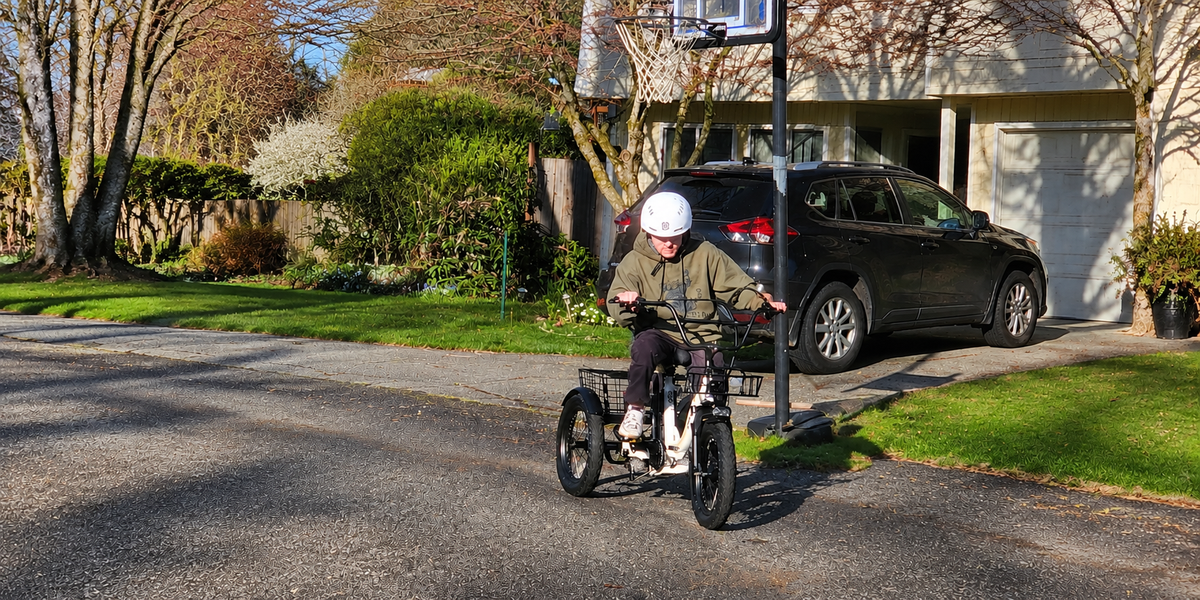
For riders who feel uncomfortable balancing a bicycle at every stop, an electric trike offers a different way to enjoy nearby journeys. Three wheels support the vehicle on firm, level ground, so stopping at a junction or outside a local store no longer requires the same balancing effort.
Once moving, the rider has different things to learn: leaving room for the rear wheels, navigating entrances, and approaching corners at a suitable speed.
The standard ESKUTE T300 combines three-wheel support, a rear differential, and a parking brake for everyday use. Understanding their roles helps buyers decide whether the T300 addresses their riding concerns—and what to expect when making the move to a trike.

How Does the Three-Wheel Design Affect Riding Stability?
The T300 has one front wheel and two rear wheels. On firm, level ground, this layout supports the trike while stationary, removing the balancing task involved in holding a two-wheel bicycle upright.
That can make a stop outside a shop or at a neighborhood junction feel more manageable. Once the trike starts moving, however, steering, clearance, and cornering become the rider’s responsibility.
Three wheels provide stationary support, but they do not eliminate tipping risk while turning.
Three-Wheel vs. Two-Wheel Riding: What's Different?
For someone familiar with a bicycle, the biggest adjustment is learning how the T300 occupies space and follows a turn.
| Riding Situation | Two-Wheel E-Bike | Three-Wheel T300 |
|---|---|---|
| At a stop | The rider generally supports the bike with a foot on the ground. | The three-wheel layout supports the trike on firm, level ground; brakes keep it from rolling. |
| Turning | The bicycle normally leans into the turn. | The trike does not lean through corners in the same way; speed, steering, and rear-wheel paths need attention. |
| Moving into a parking space | The rider manages a single line of wheels while supporting the bike. | Both rear wheels need clearance, and the standard T300 must be repositioned manually when backing up. |
The T300 can make the stationary part of riding easier for someone concerned about balance. It also introduces a different handling pattern, so experience on two wheels does not replace familiarization with a trike.
What Does the Rear Differential Do on the T300?
The rear differential is one of the standard T300’s relevant handling features. Its job is to accommodate how the rear wheels travel through a turn. ESKUTE lists it on the T300 product page.
Why Do the Rear Wheels Need a Differential?
Imagine a broad turn around a corner. The rear wheel on the inside follows a shorter path, while the outside wheel travels farther.
To roll along those different paths during the same turn, the wheels need to rotate at different speeds. Forcing both to turn at the same speed can cause a tire to scrub against the ground.
How Does the Differential Help During Turns?
The T300’s rear differential allows that difference in wheel speed. The outside rear wheel can travel farther while the inside wheel follows its shorter path.
For the rider, this is relevant to ordinary maneuvers such as turning into a driveway or following a bend along a neighborhood route. It helps the rear wheels accommodate the corner instead of requiring them to cover equal distances.
Does a Rear Differential Prevent Tipping?
No. A differential manages differences in rear-wheel rotation; it is not an anti-tip system.
Turning speed, steering angle, surface slope, and load placement still affect stability. The feature supports the mechanics of a turn, but it does not make a fast or abrupt corner safe.
How Does the T300 Handle Everyday Riding Situations?
Starting and Stopping
A neighborhood errand often involves several stops. The T300’s three-wheel layout supports the rider while stationary, and its parking brake helps hold the vehicle in place when correctly engaged.
Moving away adds electric assistance to the experience. A controlled start matters when leaving a parking spot or approaching a junction, where there may be little room for an unexpected surge. The parking brake must be released before riding away.
Making Everyday Turns
Turning into a driveway involves more than guiding the front wheel through the opening. The rear wheels follow separate paths behind the rider, so both need enough clearance from gateposts, curbs, and parked vehicles.
The T300’s differential accommodates their different rotation speeds. The rider still chooses the turning line and leaves space for the whole trike. An entrance that looks wide enough from the handlebars may require a broader approach.
Riding at Low Speeds
Approaching a stopping point, passing through an entrance, or positioning the trike for parking calls for careful, unhurried control.
The T300 uses a single-speed drivetrain, so riders do not need to shift gears during these everyday maneuvers. That leaves one less task to manage while steering, selecting assistance, and braking.
Its width still matters at a slow pace. Leaving clearance for both rear wheels helps the rider navigate around gateposts, parked vehicles, and other nearby objects.
What Factors Can Affect the T300's Riding Stability?
The T300’s differential and three-wheel layout each serve a purpose, but handling also changes with the route and what the trike carries. A familiar journey home may feel different after loading shopping into the rear basket.
| Factor | What T300 Riders Should Know |
|---|---|
| Turning speed | Reduce speed before corners. The rear differential does not prevent tipping during a fast or abrupt turn. |
| Cargo distribution | Secure items in the carrying areas and distribute weight evenly within the applicable limits. Avoid loads that shift or obstruct control. |
| Road conditions | Uneven, sloped, or slippery ground can change wheel support and grip. A parking brake or differential does not compensate for an unsuitable surface. |
| Rider experience | Familiarity with steering and the paths of both rear wheels helps riders judge clearance in narrower spaces. |
These considerations explain why the same trike can feel different across outings. They are practical handling factors, not claims that the T300 has passed a particular stability test.
Is the ESKUTE T300 Suitable for First-Time Trike Riders?
For Riders Returning to Cycling
The T300 is worth considering when someone wants to resume local rides but finds balancing at stops discouraging. It addresses that specific concern while providing electric assistance for everyday journeys.
A suitable match also depends on the intended routes. Accessible neighborhood destinations and room to maneuver give the owner more opportunity to enjoy the trike. Frequent narrow passages or awkward parking arrangements may make it less convenient.
For Adults and Seniors
Age alone does not determine whether the T300 will be easy to manage. Seat fit, comfortable reach, hand strength, coordination, and awareness of surrounding space all influence suitability.
The intended rider should be able to get on and off, steer, and operate the controls without strain. Where a trial ride is available, those movements are more informative than simply sitting on the seat.
For a family purchasing on someone else’s behalf, involving the recipient in these checks helps establish whether the trike fits their abilities and routine.
What Should Beginners Practice First?
A first session should establish a few repeatable movements before adding traffic or tighter spaces:
- Identify the controls. Learn the brakes, parking brake, and assistance controls before moving.
- Choose an open, level area. Use firm ground with clear space around the trike.
- Begin with the lowest assistance setting. Become familiar with how the trike moves away.
- Repeat controlled starts and stops. Work toward stopping smoothly where intended.
- Practice broad, slow turns. Learn where both rear wheels travel before attempting narrower passages.
The aim is to make these actions familiar enough that the rider can pay attention to the surroundings. That confidence—not simply having a third wheel—is what makes everyday use more manageable.
ESKUTE T300 Stability FAQs
Is a Three-Wheel Electric Trike More Stable Than a Two-Wheel E-Bike?
A three-wheel electric trike offers an advantage when stopping: it can remain upright without the rider having to balance it like a two-wheel bike. This can make starting and stopping feel more manageable for riders who are less comfortable balancing on two wheels. However, cornering still requires care, as a trike can tip if turned too quickly.
Does the ESKUTE T300 Have a Rear Differential, and Why Does It Matter?
Yes. The standard ESKUTE T300 features a rear differential that allows its two rear wheels to rotate at different speeds when turning. The outside wheel travels farther than the inside wheel through a corner, so the differential accommodates that difference and helps the trike turn more naturally.
Can the ESKUTE T300 Tip Over When Turning?
Yes. Three wheels do not make a trike immune to tipping. Taking a corner too quickly, making a sudden steering movement, or carrying an unevenly distributed load can increase the risk. Slow down before turning, keep cargo secured, and use smooth steering inputs.
Do You Need to Hold the T300 Upright When Stopping?
No. On firm, level ground, the T300's three-wheel design supports the trike without requiring the rider to balance it upright. However, always engage the parking brake when leaving the trike stationary, particularly on a slight incline.
Is the ESKUTE T300 Suitable for Seniors?
It can be a practical option for seniors who want electric assistance, carrying space, and support when stopping. Its three-wheel layout removes the need to balance the trike at a standstill. However, buyers should check whether the intended rider can comfortably reach the handlebars and brakes, get on and off, and manage the trike's 93 lb weight.
Is an Electric Tricycle Difficult for Beginners to Ride?
Most beginners will need some practice because steering and cornering feel different from riding a two-wheel bicycle. Start in an open, level area, practice moving off and stopping, and take wide turns at a slow speed. Once comfortable with the trike's width and turning behavior, gradually move on to more familiar everyday routes.
Enjoy More Confidence in Your Everyday Rides
The ESKUTE T300 brings together support at stops, a rear differential for turning, and a single-speed drivetrain that keeps gear changes out of the routine. For someone returning to cycling, these features address practical concerns that can otherwise put nearby rides on hold.
A visit to a friend or a trip to the local store becomes more appealing when the rider feels comfortable starting, stopping, and maneuvering. The T300 is worth considering for those everyday journeys, with time set aside to get familiar with its handling.
Explore the standard T300’s fit, features, and available purchase options to see how it could become part of the daily routine.


Share:
ESKUTE T300 Review: Is This Folding Electric Trike Worth Buying?
ESKUTE T300 Range: Can 65 Miles Handle Your Everyday Trips?