


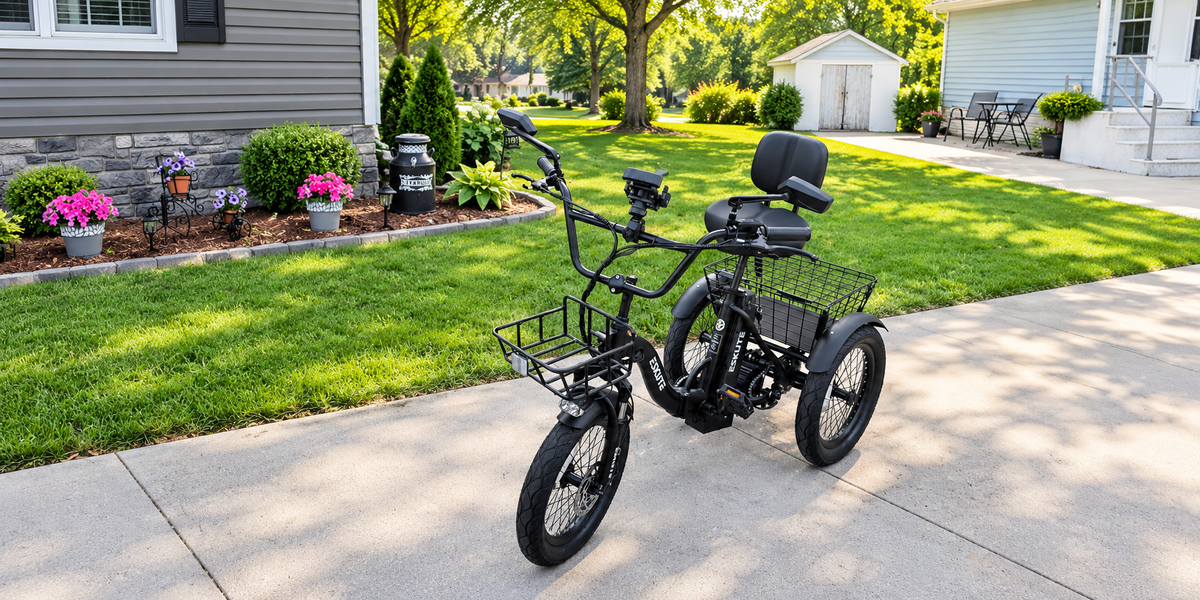
A morning trip to the store, a visit to a friend after lunch, and a relaxed neighborhood ride later in the day can add up. For someone considering an electric trike, the question is whether those journeys fit into one charge—or require a stop at home to recharge.
The standard ESKUTE T300 uses a removable 48V 13Ah battery and advertises up to 65 miles of range. That gives buyers a reference point, but everyday riding includes things a headline number cannot describe: shopping added halfway through the trip, an uphill return, and repeated stops along the way.
Understanding those details helps answer the useful question: will the T300’s battery suit the trips its owner actually wants to take?
Understanding the ESKUTE T300's 48V 13Ah Battery
The battery stores the energy used to provide electric assistance. Its capacity matters, but the distance available also depends on how quickly that energy is used.
| Battery Specification | Details |
|---|---|
| Nominal voltage | 48V |
| Capacity | 13Ah |
| Battery type | Lithium-ion |
| Calculated nominal energy | Approximately 624Wh |
| Advertised range | Up to 65 miles |
| Removable for charging | Yes |
Battery configuration and advertised range are listed on the standard T300 product page. Nominal energy is calculated as 48V × 13Ah.
In simple terms, voltage describes the battery’s electrical system, while amp-hours describe its charge capacity. Together, they indicate approximately 624Wh of nominal stored energy. That figure cannot be converted directly into a guaranteed riding distance.
The phrase “up to 65 miles” describes an advertised maximum, not a verified result for every owner. An easy ride and a loaded journey with repeated climbs can draw from the same battery at different rates.
For buyers looking for a 65-mile electric trike, the important distinction is between the advertised maximum and the distance needed for an ordinary round trip.
What Affects the Real-World Range of the T300?
Rider Weight and Cargo Load
Greater total weight increases the energy needed to accelerate and climb. Rider weight and carried items therefore influence how quickly the battery is used.
The T300’s 400 lb maximum payload includes the rider and cargo. This is a loading limit, not a guarantee of achieving the advertised range at that weight.
Riding Terrain and Hills
Climbing requires energy to lift the trike and its load. A route with repeated hills can consume more battery than a flatter route of the same length.
The length of each climb matters too. A brief rise and a sustained ascent place different demands on the available charge.
Pedal Assistance and Riding Habits
Higher assistance generally draws more energy from the battery, while the rider’s pedaling contribution affects how much work the electrical system performs.
Repeated starts also require energy to bring the trike back up to speed. Several stop-and-go journeys can use charge differently from a continuous ride covering the same distance.
Riding Speed
Sustained higher speeds generally increase energy demand, particularly through air resistance. A moderate, consistent pace can help conserve charge compared with repeatedly accelerating to higher speeds.
Battery Condition and Temperature
Battery capacity changes with age and use, while temperature affects the energy available during a ride. Colder conditions may leave less usable range than an owner has become accustomed to in warmer weather.
Can the T300 Handle Different Types of Everyday Trips?
Short Neighborhood Errands
A quick trip to the store, a visit to a friend, and an afternoon neighborhood ride may each seem small. Together, they make up the day’s battery use.
For this routine, add up the round trips rather than considering each outing separately. Returning home provides a convenient opportunity to check the battery indication before deciding on another ride.
The removable battery also makes charging easier to arrange. An owner without an outlet beside the parking space can take the battery to a suitable indoor charging location, leaving the trike where it is stored. Follow the supplied charging instructions and allow enough time; a brief stop at home does not automatically replenish the energy used.
Shopping Trips with Extra Cargo
The morning ride to the store begins with empty baskets. The road slopes gently downward, and the journey feels easy. After shopping, groceries add weight, and that descent becomes the climb home.
The outward journey has only told half the story.
The return now involves moving a heavier load uphill, possibly with several stops along the way. Judging the whole trip by the easy outward leg can leave too little allowance for getting home.
For a T300 buyer, the useful route to evaluate is the one traveled after shopping. Consider the usual purchases, the climb home, and any extra stops made before returning.
Owners can begin with a familiar route and a smaller shop, then observe battery use over several comparable outings. That provides a practical basis for adding another destination or carrying more within the permitted limits. Keep a reserve for the loaded return rather than using the remaining charge to extend the outward journey.
Longer Weekend Leisure Rides
A weekend ride introduces a different decision: how far to travel before turning back.
Plan the complete route, including the return, before adding optional detours. A loop with opportunities to shorten the journey offers more flexibility than a distant destination with only one way home.
Build toward longer outings using experience from familiar rides. The battery indication is useful for monitoring progress, but it is not an exact prediction of miles remaining.
A charging stop can be included when permission, suitable facilities, the correct charger, and sufficient time are confirmed. It should be an arranged part of the outing, rather than a hoped-for outlet at the destination.
How Can You Get the Most Out of Your T300 Battery?
These habits help owners manage the available charge without making every ride an exercise in battery watching.
Choose an Appropriate Assistance Level
Use assistance that suits the route and the rider’s comfortable effort. Avoid leaving it at a higher setting solely out of habit, while still using the support needed to ride comfortably and maintain control.
Maintain a Steady Riding Pace
Where conditions allow, settle into a consistent pace rather than repeatedly speeding up and slowing down. Traffic, visibility, and safe cornering always take priority over conserving energy.
Avoid Unnecessary Hard Acceleration
Build speed gradually after stops. There is little benefit in using a strong burst of assistance when another junction or stopping point is close ahead.
Check Tire Pressure Regularly
Keep tire pressure within the applicable tire and vehicle guidance, and inspect tire condition. Do not inflate beyond the permitted limit in pursuit of extra range.
Follow Proper Battery Charging and Storage Practices
Use the supplied or manufacturer-approved charger and follow the battery’s charging and storage instructions. Before an outing, check the charge actually available rather than assuming it is unchanged since the previous ride.
Is the ESKUTE T300's 65-Mile Range Enough for Your Lifestyle?
The decision becomes clearer when the advertised figure is connected to the most demanding part of a normal day.
| Riding Routine | What to Evaluate |
|---|---|
| Nearby errands and visits | The combined round-trip distance of the day’s outings. |
| Regular shopping trips | The loaded journey home, including hills and additional stops. |
| Longer weekend rides | The complete route, return reserve, and opportunities to shorten the outing. |
For nearby shopping and short visits, start with the distances traveled regularly. These familiar journeys are easier to evaluate than an occasional ambitious route.
For frequent cargo use, give the return trip more weight in the decision. An empty-basket ride does not fully represent the battery demand of the weekly shop.
Long-distance leisure riders need a firmer understanding of their actual range before committing to a route that leaves few alternatives. Before purchase, comparable riding evidence is useful; after purchase, shorter familiar outings help establish a personal reference.
If regular routes fit comfortably within the range established through actual rides, the T300 can become a convenient part of an everyday routine.
Its removable battery adds to that convenience. Riders can organize charging around a suitable location without needing to bring the entire trike to an outlet—a practical benefit when parking and charging happen in different places.
ESKUTE T300 Range & Battery FAQs
How Far Can the ESKUTE T300 Go on a Single Charge?
The standard ESKUTE T300 has an advertised range of up to 65 miles per charge and uses a removable 48V 13Ah lithium-ion battery. Actual range depends on rider weight, cargo, terrain, assistance level, speed, battery condition, and temperature.
Is 65 Miles Enough for Daily Errands?
The advertised figure is a useful starting point for evaluating short neighborhood and shopping trips. Whether one charge covers the day depends on the combined distance and riding conditions. Plan around regular round trips rather than assuming every charge will deliver 65 miles.
Does Carrying Groceries Reduce the T300's Range?
Yes, added weight can reduce range by increasing the energy needed to accelerate and climb. A loaded uphill return can use more energy than the empty outward journey. Keep rider and cargo weight within the 400 lb overall payload limit and respect individual carrying limits.
Can I Ride the T300 All Day on One Charge?
Several short outings may fit within one charge, while continuous riding or repeated climbs can use considerably more energy. Add up the planned distances and leave a reserve for returning home. Breaks alone do not replenish the battery.
Can I Remove the T300 Battery to Charge It?
Yes. The removable 48V 13Ah battery can be taken to a suitable indoor charging location without moving the entire trike. Follow the supplied manual for removal and installation, and ensure the battery and seat are securely locked before riding.
How Can I Get More Range from My T300?
Use an appropriate assistance level, accelerate smoothly, maintain a suitable steady pace, and keep tires correctly inflated. Follow the recommended charging and storage practices. These habits help manage energy use without guaranteeing a specific riding distance.
Plan Your Everyday Rides with Confidence
The ESKUTE T300 pairs a removable 48V 13Ah battery with an advertised range of up to 65 miles and carrying space for useful everyday journeys.
For someone who wants to bring shopping home, visit nearby friends, or spend more time riding around the neighborhood, that combination has a clear purpose. The removable battery also allows charging at an appropriate location without moving the entire trike beside an outlet.
Start with the trips already part of daily life—especially the loaded ride home—and explore how the standard T300 could make them more convenient and enjoyable.


Share:
ESKUTE T300 Stability: Is a Three-Wheel Electric Trike Easier to Ride?
ESKUTE T300 Cargo Capacity: Can It Handle Your Everyday Shopping?